
Infrared vs traditional sauna: an honest comparison
A traditional sauna heats the air to 70 to 100°C with an electric heater and stones. An infrared sauna uses panels that warm your body directly at 45 to 60°C air temperature. Infrared warms up faster and costs less to run. Traditional gives the classic, intense Finnish heat and steam. A hybrid gives you both.
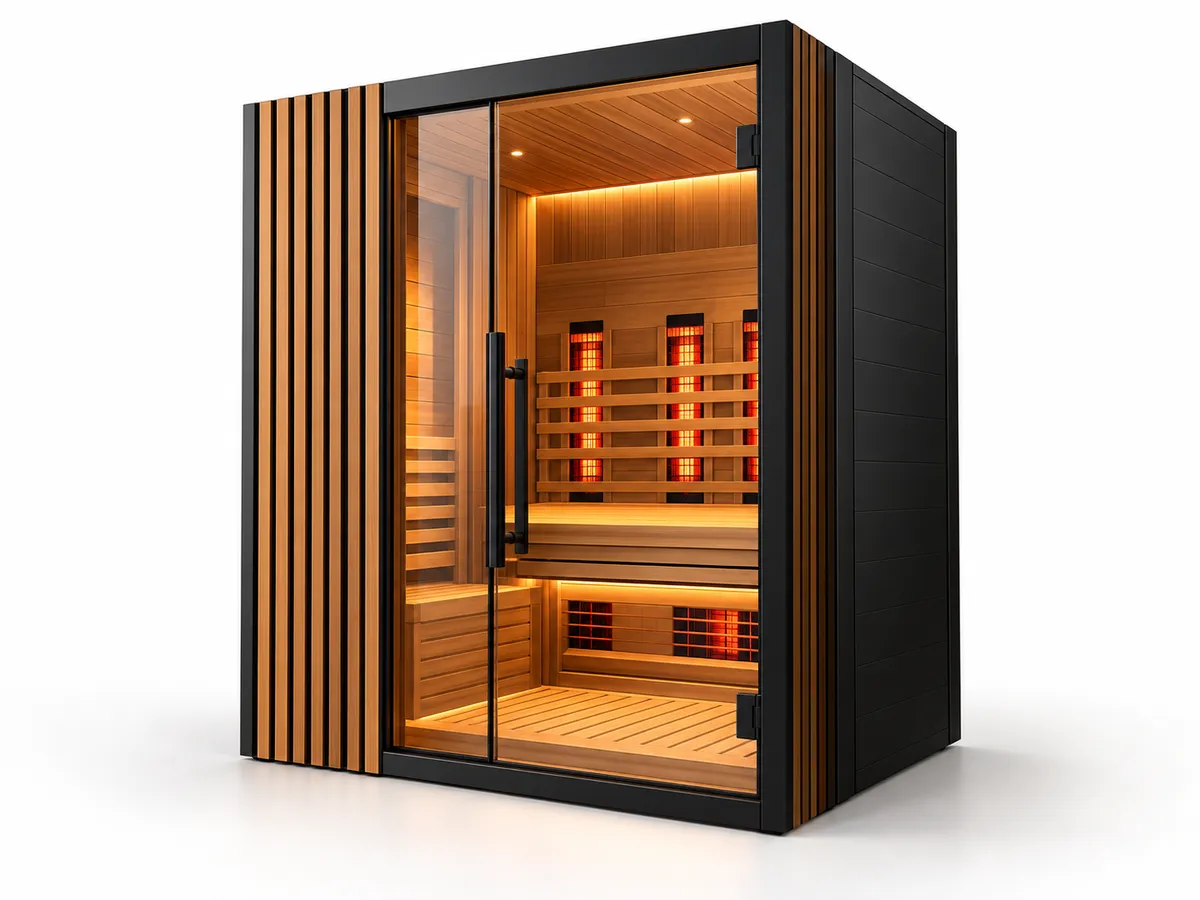 Design concept
How each one heats you
Traditional sauna. An electric heater warms a basket of stones, which heats the air in the room. Pouring water on the stones makes a burst of steam, called löyly in Finnish, that raises the humidity and the feeling of heat.
Infrared sauna. Carbon or ceramic panels give off infrared heat that warms your skin and body directly, a bit like sitting in the sun. The air stays cooler, so the session feels gentler and you can stay in longer.
Side by side
Infrared runs cooler, warms up in a third of the time and needs a quarter to a third of the power. Traditional gives higher heat and steam from the stones.
| Infrared | Traditional | Hybrid | |
|---|---|---|---|
| Air temperature | 45 to 60°C | 70 to 100°C | Either |
| Warm up time | 10 to 15 minutes | 30 to 45 minutes | Depends on mode |
| Power | 1.5 to 3 kW, single phase | 6 to 9 kW, often three phase | Both |
| Steam from stones | No | Yes | Yes |
| Smallest size | About 1.2 x 1.2 m | About 1.5 x 1.5 m | About 2 x 2 m |
| Starting price | AED 18,500 | AED 26,500 | AED 29,500 |
Which one should you pick?
Pick infrared for small rooms and apartments, traditional for the classic Finnish experience, and hybrid when the household wants both.
- Pick infrared for apartments, small rooms, quick daily sessions, and people who find high heat uncomfortable.
- Pick traditional if you have used saunas in Europe and want the real thing: high heat, steam, and the ritual of water on the stones.
- Pick hybrid if two people in the house want different things. Our Project 01 is a hybrid with a Himalayan salt wall.
What a home sauna costs to run on DEWA
Most home saunas in Dubai cost between AED 12 and AED 70 a month in electricity, used four times a week. Infrared sits at the bottom of that range, a large traditional heater at the top.
| Room and heater | Per session | Per month |
|---|---|---|
| Infrared, two person, 2 kW panels | 1.8 kWh | AED 12 to 14 |
| Traditional, small room, 6 kW heater | 6 kWh | AED 39 to 45 |
| Traditional, 2 x 2 m with glass, 9 kW heater | 9 kWh | AED 58 to 67 |
| Steam room, 2 x 2 m tiled, 9 kW generator | 4 kWh | AED 26 to 30 |
Our estimate. Assumes 17 sessions a month, a 45 minute warm up and a 30 minute session for traditional saunas (heater at full power to warm up, then cycling at about half power), 55 minutes for infrared, and 40 minutes for steam. Priced at 38 to 44 fils per kWh, which is DEWA's 32 and 38 fils slabs plus the fuel surcharge, where most Dubai villas sit for much of the year. VAT is extra. Check the current rates on the DEWA slab tariff page.
What to watch for when buying infrared
Ask which panels are used, carbon or ceramic, and their warranty. Ask where the panels sit: good builds place them at the back, sides and calves so heat reaches the whole body. Avoid cheap units with exposed wiring or low grade timber that gives off a smell when hot.
Sources
Figures on this page come from our own builds in Dubai and from these references.
- DEWA slab tariff, electricity rates for Dubai homes
- Harvia heater installation manuals, heater output by room volume
Questions
Is an infrared or a traditional sauna better?
A traditional sauna heats the air to 70 to 100°C and gives you the classic Finnish heat with steam from the stones. An infrared sauna runs at 45 to 60°C and warms your body directly, so it heats up faster and feels gentler. A hybrid gives you both in one room.
Can I install a sauna in an apartment?
Yes, in most cases. Infrared saunas suit apartments because they need no water, little ventilation and a standard power supply. You will need building management approval for the electrical work, which we help you prepare.
How much does a home sauna cost to run?
Running cost depends on the heater size and how often you use it. An infrared sauna draws around 1.5 to 3 kW and a traditional heater around 6 to 9 kW. Multiply the heater size by your session length and your DEWA tariff to estimate a session.
What electrical supply does a sauna need?
Every sauna needs its own dedicated circuit from your distribution board. Infrared saunas usually run on a standard single phase supply. Traditional heaters of around 9 kW often need a three phase supply. We check your board at the site visit and our electrician installs and tests the circuit.